Commentaries on the Laws of England, Book I: Of the Rights of Persons by Sir William Blackstone
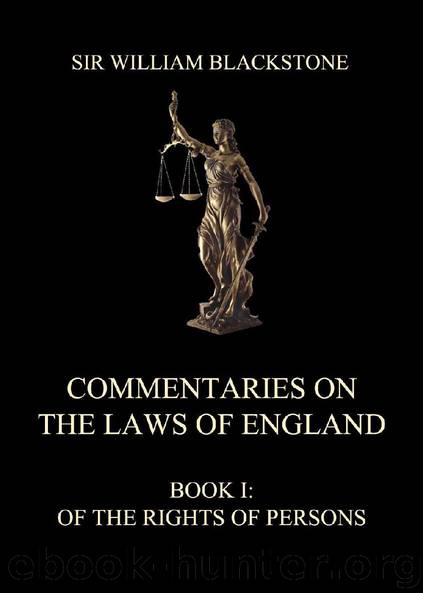
Author:Sir William Blackstone [Blackstone, Sir William]
Language: eng
Format: epub
Tags: Politikwissenschaft
Publisher: Jazzybee Verlag
Published: 2017-07-26T22:00:00+00:00
CHAPTER X.: OF THE PEOPLE, WHETHER ALIENS, DENIZENS, OR NATIVES.
Having, in the eight preceding chapters, treated of persons as they stand in the public relations of magistrates, I now proceed to consider such persons as fall under the denomination of the people. And herein all the inferior and subordinate magistrates treated of in the last chapter are included.
The first and most obvious division of the people is into aliens and natural-born subjects. Ref 1242 Natural-born subjects are such as are born within the dominions of the crown of England; that is, within the ligeance, or, as it is generally called, the allegiance, of the king; and aliens, such as are born out of it. Allegiance is the tie, or ligamen, which binds the subject to the king, in return for that protection which the king affords the subject. The thing itself, or substantial part of it, is founded in reason and the nature of government; the name and the form are derived to us from our Gothic ancestors. Under the feodal system, every owner of lands held them in subjection to some superior or lord, from whom, or whose ancestors, the tenant or vassal had received them; and there was a mutual trust or confidence subsisting between the lord and vassal, that the lord should protect the vassal in the enjoyment of the territory he had granted him, and, on the other hand, that the vassal should be faithful to the lord, and defend him against all his enemies. This obligation on the part of the vassal was called fidelitas, or fealty; and an oath of fealty was required, by the feodal law, to be taken by all tenants to their landlord, which is couched in almost the same terms as our ancient oath of allegiance; Ref 1243 except that in the usual oath of fealty there was frequently a saving or exception of the faith due to a superior lord by name, under whom the landlord himself was perhaps only a tenant or vassal. But when the acknowledgment was made to the absolute superior himself, who was vassal to no man, it was no longer called the oath of fealty, but the oath of allegiance; and therein the tenant swore to bear faith to his sovereign lord, in opposition to all men, without any saving or exception:—“contra omnes homines fidelitatem fecit.” Ref 1244 Land held by this exalted species of fealty was called feudum ligium, a liege fee; the vassals, homines ligii, or liege men; and the sovereign, their dominus ligius, or liege lord. And when sovereign princes did homage to each other for lands held under their respective sovereignties, a distinction was always made between simple homage, which was only an acknowledgment of tenure, Ref 1245 and liege homage, which included the fealty before mentioned, and the services consequent upon it. Thus, when our Edward III., in 1329, did homage to Philip VI. of France for his ducal dominions on that continent, it was warmly disputed of what species the homage was to be, whether liege or simple homage.
Download
This site does not store any files on its server. We only index and link to content provided by other sites. Please contact the content providers to delete copyright contents if any and email us, we'll remove relevant links or contents immediately.
Secrecy and Power by Richard Gid Powers(531)
The Real Watergate Scandal: Collusion, Conspiracy, and the Plot That Brought Nixon Down by Geoff Shepard(522)
Whistleblowers: Honesty in America From Washington to Trump by Allison Stanger(308)
Commentaries on the Laws of England, Book IV: On Public Wrongs by Sir William Blackstone(196)
Commentaries on the Laws of England, Book III: On Private Wrongs by Sir William Blackstone(189)
Commentaries on the Laws of England, Book I: Of the Rights of Persons by Sir William Blackstone(176)
Commentaries on the Laws of England , Book II: Of the Rights of Things by Sir William Blackstone(144)
